'The Mentalist'… A skillful integration of the amateur sleuth
It’s worth watching this TV series again!

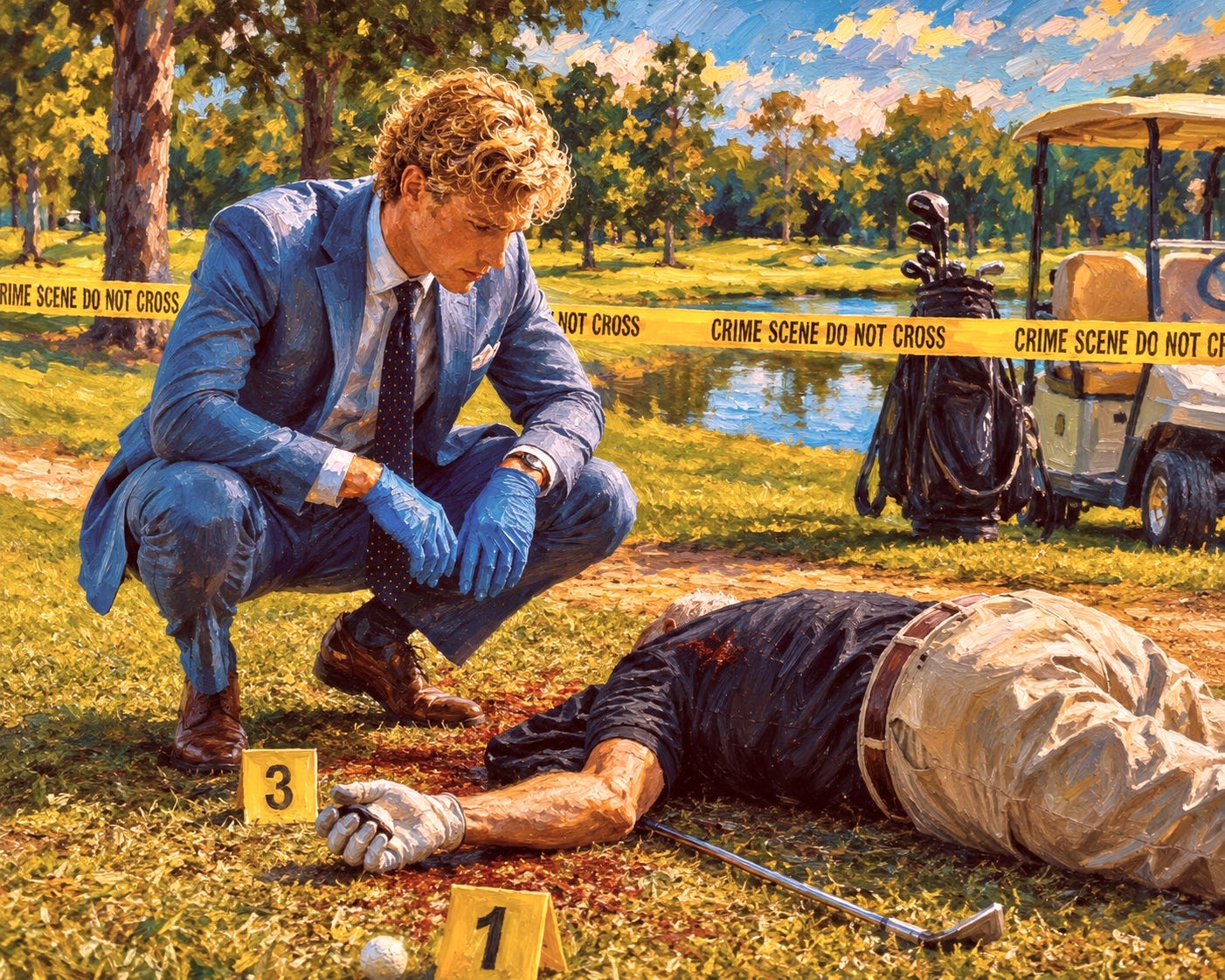
Artistic interpretation of amateur sleuth, Patrick Jane, at a crime scene.
I’ve recently been watching streaming reruns of an early 21st century murder mystery TV show. ‘The Mentalist’ originally ran on broadcast television between 2008 and 2015. I enjoyed it then, although I certainly did not get to see all the original episodes. Now you can binge on the full seven years of 24 episodes per year. It’s a fascinating whodunnit, because it’s an artful combination of a police procedural (not so exciting) and an amateur sleuth mystery (really fun).
The protagonist, the ever-charming Patrick Jane, is a former carney performer and self confessed con man who appeared in public shows as a psychic. Although he had no psychic powers, during that period of his life he develop a keen and discerning eye for human nature and the tell-tale signs of a person’s past and present. His act would have been just like taking Sherlock Holmes and putting him on the road as a quick talking entertainer. Just like Holmes, Patrick Jane can take a probing look at an individual or a death scene and discover far more than any career police detective.
The police side of this one hour weekly drama was a group of four individuals working together as police detectives for the fictitious California Bureau of Investigation, the CBI. This small unit is managed by agent Theresa Lisbon and included agents Grace Van Pelt , Wayne Rigsby and Kimball Cho. Jane is not a member of the bureau but is solely a consultant to the CBI. As a result, he visits every murder scene to supply his amateur sleuthing acumen to the rigid procedural approach of the CBI agents.
It’s a consistently entertaining mix. There is a certain formulaic appeal to the fact every episode begins with the murder. Jane soon arrives, and picks up leads for further investigation, to be carried out by the team. But for a total of 168 episodes, this formula would never have held up without a good deal of improvisation of dialog and relationships among the the 5 individuals in the team. Patrick sometimes teaches important philosophical concepts like Occam’s Razor. He flips a coin for Rigsby to guess the outcome. Time after time it comes up heads. Rigsby says how do you do that, and Jane says, “When you consider all of the possible explanations, always accept the simplest.” And of course the simplest one turns out to be that Patrick has a two-headed coin.
Although religiously proclaiming that he is not a psychic, especially when someone from his past calls him that, Patrick is not above applying skills such as hypnosis, sleight of hand and elaborate sting operations to solve crimes. Rather than relying on forensic science or interrogation-room intimidation, he solves crimes through psychological manipulation, reading body language, and orchestrating elaborate schemes to trick suspects into revealing themselves. Episodes would often build toward a moment where Jane would stage some kind of trap or performance, gathering everyone in a room and using theatrics to expose the killer.
Patrick has a love/annoyance relationship with Lisbon who is tasked by her superiors with keeping him in line. She is a moral counterweight, the person who reins in his more reckless impulses while also being quietly worn down by his charm. Another thread tying the episodes together is an arch villain known as Red John, a serial killer who was responsible for the death of Jane’s wife and daughter. Needless to say Jane has committed himself to the pursuit of Red John and bringing him to justice.
More than a decade after its finale, ‘The Mentalist’ still rewards a re-watch with solid entertainment. I’m hooked revisiting what makes these murder mystery stories work so well.
Explore more at: https://thementalist.fandom.com/wiki/The_Mentalist_Wiki
And find more stories featuring an amateur sleuth at: https://dwallacebarr.substack.com/p/obsessed-by-murder-its-not-a-mystery